The Academy
Structured online courses that combine theory and practice to master functional breathing from anywhere.
How you breathe has a profound impact on how you live. Here you will learn about that connection and how to use it to optimize your physical, emotional and mental well-being. Welcome.
Structured online courses that combine theory and practice to master functional breathing from anywhere.
Visual guide to practice breathing techniques with custom rhythms. Synchronize your breathing with precise animations.
Movement, Breathing and Attention. A weekly space to re-educate your nervous system through the body.
Free articles, research and guides with science behind each breathing technique.
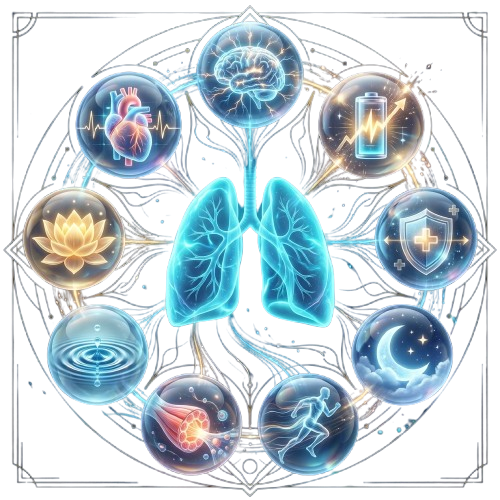
Improves brain oxygenation, increasing mental clarity and concentration.
The brain is one of the most sensitive organs to oxygen levels, depending on a constant flow to function optimally. Better oxygenation is reflected in greater mental clarity, improved concentration, and faster information processing. Oxygen plays a key role in the production of neurotransmitters such as dopamine, which influence motivation, focus, and alertness. When the brain receives enough oxygen, signals between neurons are transmitted more effectively, resulting in clearer thinking and sharper memory. In addition, maintaining good oxygenation helps protect against neurodegenerative diseases such as Alzheimer's and Parkinson's, and improves brain plasticity, strengthening neural connections and promoting both learning and long-term information retention.
It's not magic or luck: how you breathe defines how much energy you have.
Lack of energy doesn't always have to do with getting little sleep or not eating well. Often, the key is how you breathe. If oxygen doesn't reach the right amount, cells cannot generate enough energy and the body feels it: less strength, more tiredness, a scattered mind. Everything feels harder.
And there's something else. When oxygen is scarce, the body accumulates certain waste products, such as lactic acid, which make fatigue more intense and last longer. It's not just tiredness, it's that feeling of dragging your body all day, like you're missing the spark to get going.
The good thing is, you can change this. With more efficient breathing, your body makes better use of oxygen, generates more energy and recovers faster. It can be seen in the muscles, in the mind and in how you feel throughout the day.
Optimizes white blood cell performance against pathogens.
When breathing is adequate, the body achieves a balance in its internal environment that favors the coordinated work of the immune system. Thanks to better oxygen distribution and more efficient blood flow, defense cells receive the energy and resources they need to act in a timely manner.
This breathing balance helps to limit excessive inflammation and promotes tissue repair, preventing the defense mechanisms themselves from becoming harmful. So, the way we breathe directly influences how we protect ourselves and recover day by day.
Functional breathing at night prevents insomnia and improves rest.
Breathing well has much more to do with sleep than we usually think. When the breathing rhythm remains even, it is easier for nights to be calm, without those annoying interruptions that cut rest. That allows the body and the brain to reach those deep sleep phases where they really recover: tissues are repaired, defenses are reinforced, and we get out of bed with energy, not dragging ourselves.
Maximizes endurance and optimizes oxygen use during exercise.
Breathing well during the exercise not only helps us to keep moving for longer, but also makes the difference between running out fast or keeping pace even and constant. When we learn how to handle breathing, the muscles receive the oxygen needed to continue to function fully.
Helps eliminate lactic acid and reduces muscle fatigue.
The way we breathe after training also has a key role in how we recover. After intense effort, it is normal for the muscles to accumulate lactic acid, generating that feeling of stiffness and discomfort that we all know.
Functional breathing balances the autonomic nervous system by increasing resilience.
Functional breathing has a direct impact on how we handle day-to-day stress. By learning to breathe in a paused and deep way, we give the body a sign that it can relax, reducing muscle tension and helping the mind stop turning into repetitive thoughts.
Breathing practices promote self-awareness and psychological well-being.
Functional breathing is key to both the body and the mind. It allows us to take a moment, stand firm and face situations with a more serene and less reactive attitude.
It promotes circulation and relieves strain on the heart.
Breathing slower and using the diaphragm optimally helps the blood return better to the heart, without it having to work too hard. This more paused rhythm allows the flow to be more even and the entire system to work with less effort.
The breathing retraining you will find here is based on improving your breathing efficiency to produce a lasting change in breathing patterns. This improvement won’t be temporary; it will accompany you all day, every day, Not only when you’re thinking about breathing or voluntarily altering it.
It’s not about imposing a universal method, but about offering knowledge and guidance so that each person finds what they really need. We don’t all breathe the same, or look for the same. But what we do share is that, when breathing is regulated, The body finds relief, the movement becomes freer and the mind, clearer.
We are convinced—through experience—that breathing practices are one of the most accessible bridges to a life in greater fullness. We invite you to give them a chance and to discover what it means to experience a more complete oxygenation.